00THE CHALLENGE
The climate has already changed. Decisions in the field haven’t yet.
FarmPartner was born from the Field Shift: Adapting Farms with NASA Data challenge of the NASA Space Apps Challenge 2026: helping farmers adapt their land to climate change with NASA’s open data.
THE PROBLEM
Intensive farming wears out the land
Planting the same crop year after year exhausts the soil: it loses nutrients and organic matter, pests and erosion increase, and every season yields less. Crop rotation is essential to let the land recover, but choosing the right rotation means knowing each field’s climate, soil and water.
The climate is changing faster than experience
Rain, frost and heat waves no longer follow the usual calendar. What worked for decades is no longer reliable.
The data exists, but it doesn’t reach the field
NASA has been observing every plot on the planet for more than 20 years. But that data comes in technical formats, in English, and is made for scientists.
Knowledge is being lost
Many experienced farmers retire with no one to take over, and what they know is never written down.
Technology leaves many behind
Farming tools are often complex apps, in a single language, that require reading charts or being comfortable with technology.
WHAT WE SOLVE
Turning data into decisions
We have built an AI engine that reads NASA data for each field and turns it into a concrete crop rotation that brings the soil back to life, with its benefits and its risks.
Bringing science to the chat
Anyone can talk to the AI engine from the messaging apps they already use, with nothing to install. It works on WhatsApp today, and soon on Messenger, iMessage, Instagram, Line and SMS.
Generational renewal
The knowledge of experienced farmers feeds the recommendations and reaches the next generation.
Digital inclusion
Just type or send a voice note. No need to read charts or be comfortable with technology.
No language barriers
Every farmer talks to FarmPartner in their own language: 46 languages.
Support all season long
We send frost, heat and drought alerts when conditions change.
01WHAT IT DOES
Advice that fits your field, not a region’s average.
FarmPartner looks at the environmental conditions of each area (temperature, rainfall, soil moisture, vegetation health and water availability) to identify suitable crops and recommend rotation strategies. Farmers can compare what they do today with alternatives, see the likely benefits and risks, and get alerts when conditions change.
NASA Earth observation
Two decades of satellite records on climate, soil moisture, vegetation and water, for any field on the planet.
Your farm
Location, water, current crops and priorities, plus your corrections when the data doesn’t match what you see in the field.
Farmers’ experience
Practical knowledge on crops, soils, planting windows and regional conditions, organized into a knowledge base the AI consults.
02HOW IT WORKS
From a location pin to a rotation you can trust.
An integrated process: collect what matters about your farm, analyze the data, and turn it into recommendations you can act on.
- 01
Tell us about your farm
Share basic information about your land: location, water availability, current crops and farming priorities. You can also correct or adjust the environmental data so it better reflects the real conditions of your field.
- 02
We read NASA data for your field
The platform brings together several NASA datasets, harmonizes them and adds local weather forecasts, combining long-term environmental patterns with short-term information.
See the datasets ↓ - 03
AI analyzes and recommends
AI weighs the environmental data alongside your farm’s details to identify suitable crops and propose alternative rotation strategies. You get your current rotation compared with at least two alternatives, with explanations, supporting data, expected benefits, possible risks and the data gaps to keep in mind.
See a sample report ↓ - 04
Farmer knowledge, built in
Experienced farmers contribute practical know-how on crops, soils, planting periods and regional conditions. It is organized into a knowledge base the AI consults, so every recommendation combines scientific evidence with real field experience.
- 05
Ongoing support
FarmPartner sends weather alerts, spots chances to make better use of the land between harvests and suggests cover crops or alternative uses such as grazing. Just ask the chatbot, by text or voice note, whenever you need it.
- 06
Global knowledge exchange
NASA data covers the whole planet, so FarmPartner can connect farming communities facing similar climates. Through climate-analogue analysis, farmers discover regions already living the conditions their own area may face in the future, and learn from how they adapted.
03SAMPLE REPORT
Every conversation ends in a field report.
When a farmer talks to the FarmPartner engine through a messaging app (for now, WhatsApp), the chatbot answers right in the chat and sends back a link to a full field report like this one. It is a real example, generated by the engine for a dryland farm in Finney County, Kansas.
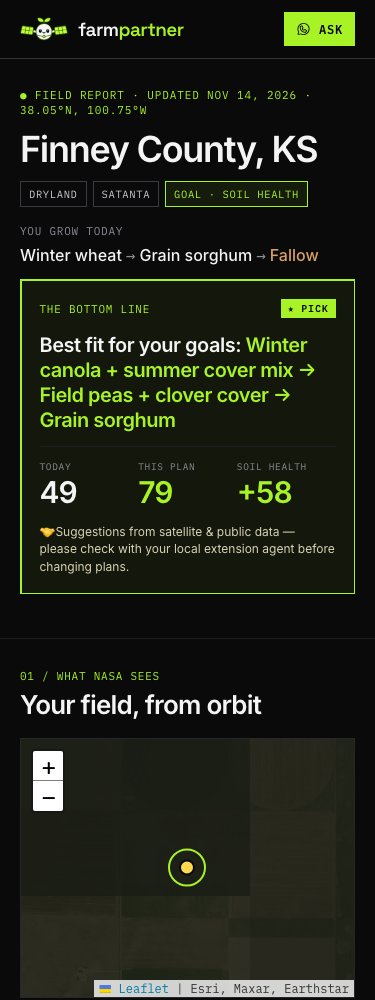
● IN THE CHAT
📍 Location pin · wheat → sorghum · goal: soil health
Your field report is ready 🌱
farmpartner.space/r/…
WHAT’S INSIDE
- The bottom lineThe rotation that best fits your goals, scored against what you grow today.
- What NASA seesYour field from orbit, rainfall and water balance, frost and heat, soil moisture and groundwater trends.
- Today vs. two alternativesRotations compared on water use, soil health, erosion, pest breaks, income potential and drought resilience.
- Why it fitsThe evidence behind each option and the risks to check locally.
04NASA DATA
Five NASA missions, read for one field.
Each dataset answers a different question about your land. Together, and alongside local forecasts, they describe the past and near future of your field’s climate.
NASA POWER
20 years of rain, temperature and root-zone wetness: evaporation demand, frost dates, heat-stress and heavy-rain days.
MODIS NDVI
How green the field is through the year, and the months the soil lies bare.
SMAP
Root-zone and surface soil moisture now versus earlier months.
ECOSTRESS
Field-scale (70 m) crop water stress: whether the crop is short of water.
GRACE · GRACE-FO
Long-term trends in water storage, groundwater included.
Every source →
USDA crop and soil maps, FAO, Open-Meteo, 3,663 field trials, long-term experiments and a library of farm handbooks.
05WHERE TO FIND IT
In the apps you already use. No app to learn.
There is nothing to install or learn. The AI engine is connected to a chatbot that lives inside everyday messaging apps: farmers simply write or send a voice note, in their own language. That makes advanced agricultural technology accessible even to farmers with limited digital skills.
- WhatsApp LIVECHAT NOW →
- Messenger SOON
- iMessage SOON
- Instagram SOON
- Line SOON
- SMS SOON
Text or voice notesSeveral languagesFreeOpen source (MIT)
06BENEFITS & IMPACT
Good for the land, the farm and the people who work it.
Healthier soils, smarter water
More sustainable rotations, healthier soils, efficient water use, less land degradation and farming that is more resilient to climate change.
Better-informed decisions
Better-grounded crop choices, more diversified production, lower climate risk and new ways to improve productivity and profitability.
Knowledge that isn’t lost
Preserves the knowledge of experienced farmers, helps new generations into farming and builds an international community to share practical know-how, whatever the language or location.
Advanced, yet easy
Advanced agricultural information through a chatbot in the messaging apps people use every day. No app to install, no training, practically no learning curve.
07WHAT’S DIFFERENT
Not generic advice. Recommendations built for your conditions, your resources and your priorities.
One answer
NASA satellite observations, artificial intelligence and accumulated farmer experience, working together instead of in separate tools.
Learn from your future
An international knowledge exchange lets farmers learn from regions already experiencing the climate that may reach them.
Science, by voice and text
Scientific data and farm experience turned into clear recommendations through natural conversations. No technical knowledge or complex data entry needed.
08WHAT WE HOPE TO ACHIEVE
From a hackathon to a global farming network.
Validate in real fields
Develop and validate FarmPartner with farmers in different agricultural regions, measuring how accurate and useful its recommendations are in real growing conditions.
Build the network
An international agricultural knowledge network connecting farmers, researchers, universities, cooperatives and organizations across the sector.
Resilient farming, everywhere
An accessible decision-support tool that helps farming communities everywhere anticipate climate challenges, protect natural resources and build a more sustainable, resilient agriculture.
■ FarmPartner supports, and does not replace, farmer judgment and local agronomic expertise.